Projects
Montrose Regional Airport (MTJ)
Taxiway C&D Reconstruction
PROJECT OBJECTIVE
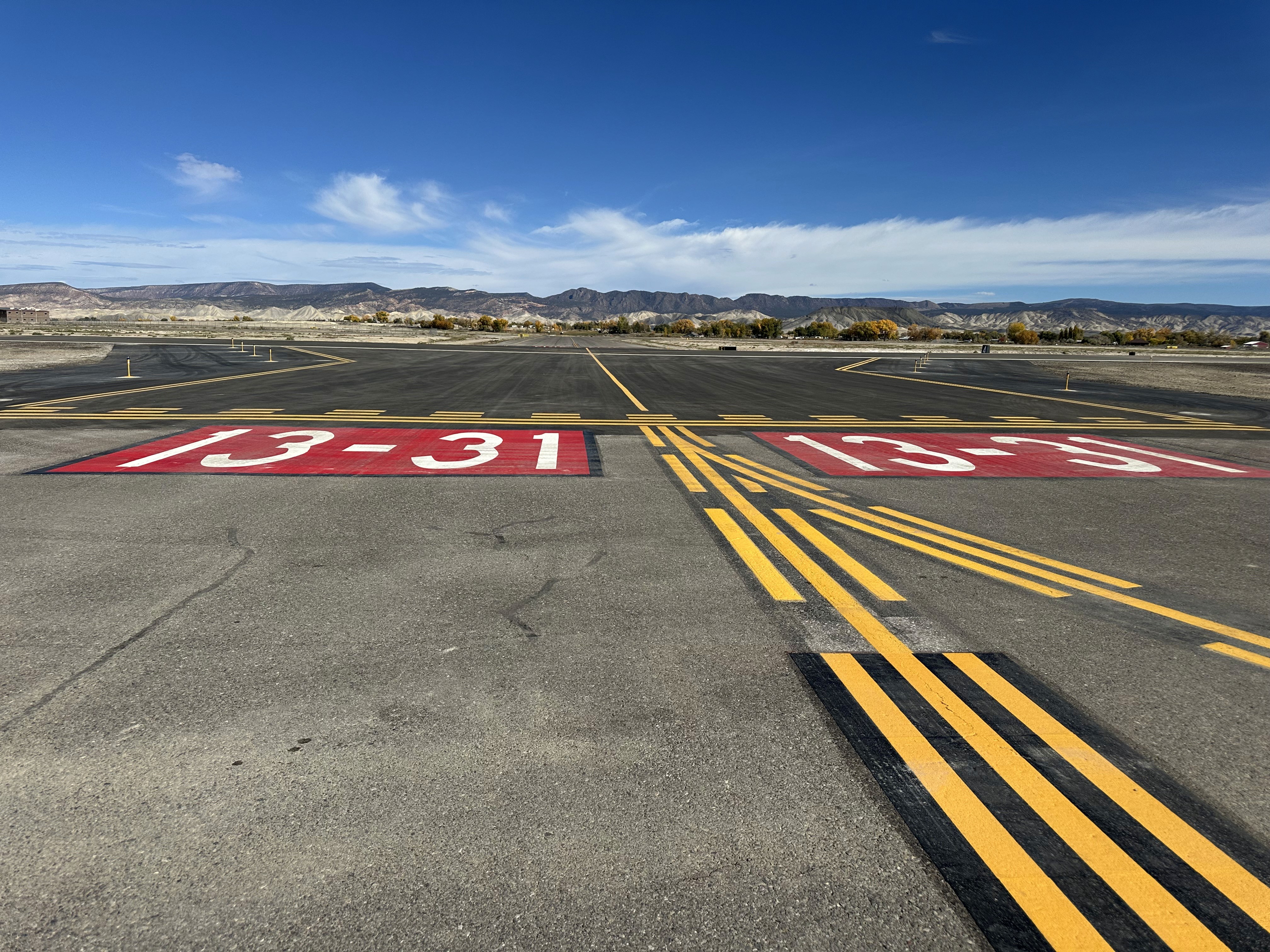
The objective of this project located at the Montrose Regional Airport was toreconstruct Taxiways C and D at Runway 13/31. Due to its current condition, these portions of taxiways will need to be removed and reconstructed. This reconstruction will also include updating this pavement to meet the current FAA geometry standards (AC 150/5300-13B). This will also include realigning taxiway edge lighting.
PROJECT SCOPE
The scope of this project included the following major design elements:
New Taxiway and Runway Pavement and Taxiway Shoulders
New Underdrain System
New Taxiway Edge Lights
New Taxiway and Runway Pavement Markings
Aeris Engineering (Aeris) provided construction administration, Resident Project Representative (RPR), and closeout services specific to the construction of the two taxiway intersections.
Aeris completed the Issued for Construction Plans and Contract Documents, prepared the Construction Management Plan (CMP), Reviewed Material Submittals, Requests for Information, and prepared any required change orders. Aeris also provided a full-time on-site Resident Project Representative (RPR) to ensure the project is completed in accordance with the plans and specifications.
Montrose Regional Airport (MTJ)
Taxiway C&D Reconstruction
PROJECT OBJECTIVE
The objective of this project located at the Montrose Regional Airport was toreconstruct Taxiways C and D at Runway 13/31. Due to its current condition, these portions of taxiways will need to be removed and reconstructed. This reconstruction will also include updating this pavement to meet the current FAA geometry standards (AC 150/5300-13B). This will also include realigning taxiway edge lighting.
PROJECT SCOPE
The scope of this project included the following major design elements:
New Taxiway and Runway Pavement and Taxiway Shoulders
New Underdrain System
New Taxiway Edge Lights
New Taxiway and Runway Pavement Markings
Aeris Engineering (Aeris) provided construction administration, Resident Project Representative (RPR), and closeout services specific to the construction of the two taxiway intersections.
Aeris completed the Issued for Construction Plans and Contract Documents, prepared the Construction Management Plan (CMP), Reviewed Material Submittals, Requests for Information, and prepared any required change orders. Aeris also provided a full-time on-site Resident Project Representative (RPR) to ensure the project is completed in accordance with the plans and specifications.
Nucla Hopkins Field Airport (AIB)
Runway 5-23 Seal Coat and Pavement Maintenance
PROJECT OBJECTIVE
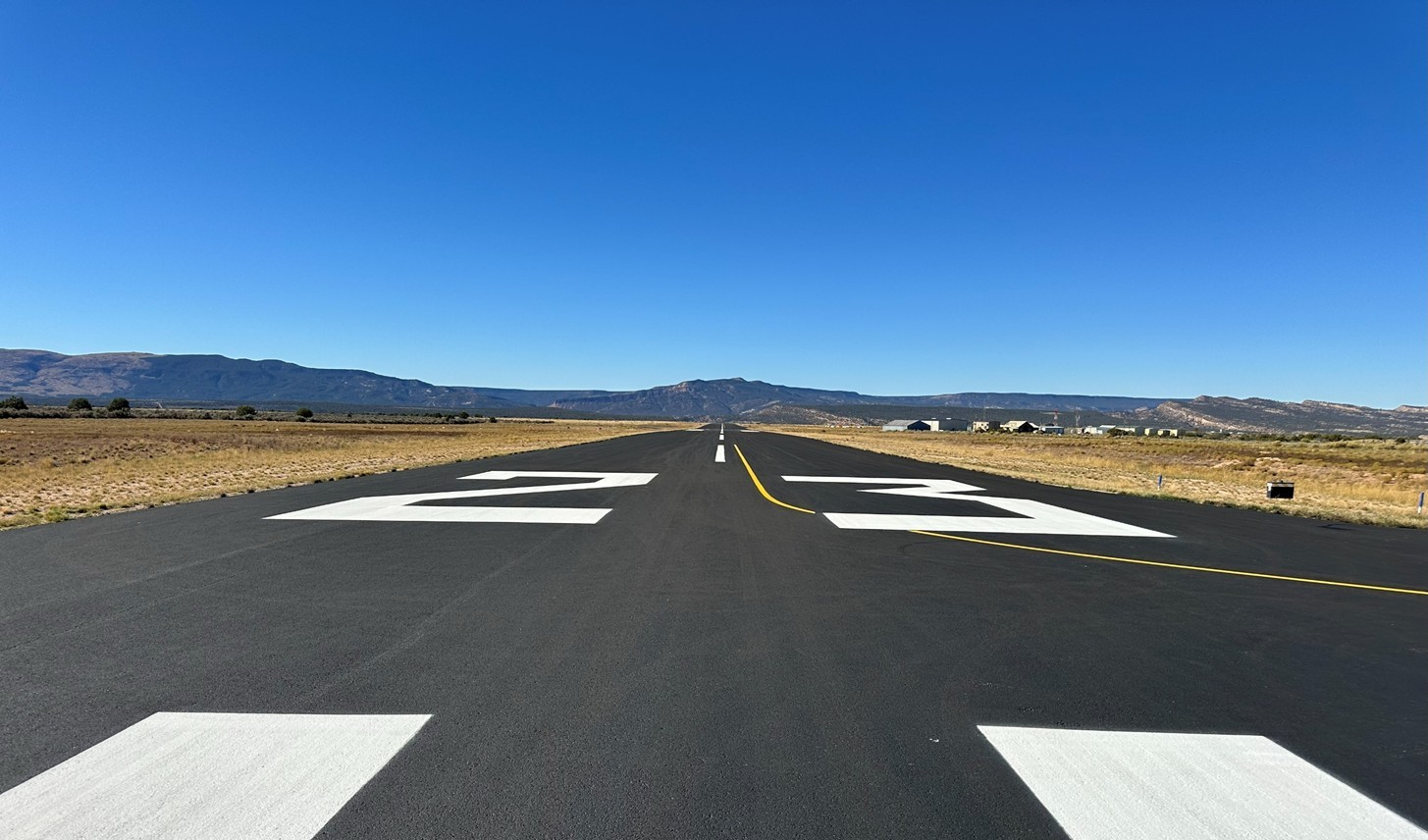
The objective of this project located at Nucla Hopkins Field Airport was to conduct a pavement seal coat of Runway 5/23 and associated taxiways. This will include a seal coat of existing pavement and installation of new pavement markings.
PROJECT SCOPE
The scope of this project included the following major design elements:
Seal Coat of Existing Runway and Taxiway Pavements
New Runway and Taxiway Pavement Markings
Aeris Engineering (Aeris) provided airfield civil engineering design services for the project including construction safety and phasing, rehabilitation layout, and pavement markings.
Aeris prepared all required construction plans, contract documents and technical specifications. Aeris also reviewed material submittals, requests for information, and prepared any required change orders. A full time Resident Project Representative (RPR) was on-site to ensure the project is constructed in accordance with the plans and specifications.
Nucla Hopkins Field Airport (AIB)
Runway 5-23 Seal Coat and Pavement Maintenance
PROJECT OBJECTIVE
The objective of this project located at Nucla Hopkins Field Airport was to conduct a pavement seal coat of Runway 5/23 and associated taxiways. This will include a seal coat of existing pavement and installation of new pavement markings.
PROJECT SCOPE
The scope of this project included the following major design elements:
Seal Coat of Existing Runway and Taxiway Pavements
New Runway and Taxiway Pavement Markings
Aeris Engineering (Aeris) provided airfield civil engineering design services for the project including construction safety and phasing, rehabilitation layout, and pavement markings.
Aeris prepared all required construction plans, contract documents and technical specifications. Aeris also reviewed material submittals, requests for information, and prepared any required change orders. A full time Resident Project Representative (RPR) was on-site to ensure the project is constructed in accordance with the plans and specifications.
Daniel K. Inouye International Airport (HNL)
Taxiway A Reconstruction
PROJECT OBJECTIVE
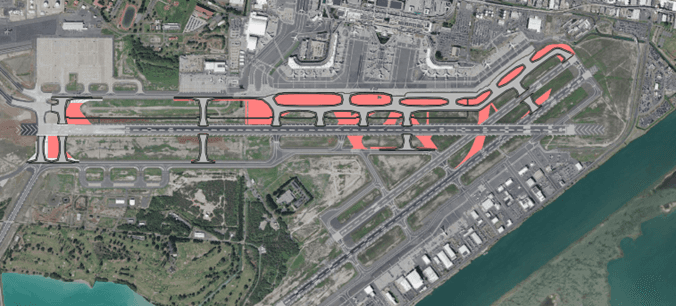
The objective of this project located at the Daniel K. Inouye International Airport was to correct multiple FAA safety “Hot Spots” and other areas of problematic and/or non-standard taxiway geometry, to increase airfield safety and capacity. The project will replace significant areas of failed or deteriorated pavement that is well past its service life. It includes includes reconstruction and realignment of existing Taxiway A between Taxiway G and Runway 22R, construction of new connector taxiways between Taxiways A and Z, and construction of new runway entrance/exit taxiways to Runways 8L-26R and 4L-22R. The scope also includes realignment of Taxiway Z east of existing Taxiway E.
PROJECT SCOPE
The scope of this project included the following major design elements:
Reconstruction and realignment of existing Taxiway A between Taxiway G and Runway 22R;
Construction of new connector taxiways between Taxiways A and Z;
Construction of new runway entrance/exit taxiways to Runways 8L-26R and 4L-22R;
Realignment of Taxiway Z east of existing Taxiway E
Aeris Engineering (Aeris) provided airfield civil engineering design services specific to the construction safety and phasing plans (CSPP) including field investigations.
As the lead for the construction phasing design, Aeris was responsible for developing the Construction Safety and Phasing Plans (CSPP), including the analysis of aircraft movement simulations adjacent to work areas, aircraft parking and pushback plans, jet blast analysis, barricade placements, declared distances, open/closed or restricted runway or taxiway routes, and gate/apron restrictions. Aeris also attended and presented at key stakeholder phasing workshops and Safety Risk Assessment (SRA) meetings.
Daniel K. Inouye International Airport (HNL)
Taxiway A Reconstruction
PROJECT OBJECTIVE
The objective of this project located at the Daniel K. Inouye International Airport was to correct multiple FAA safety “Hot Spots” and other areas of problematic and/or non-standard taxiway geometry, to increase airfield safety and capacity. The project will replace significant areas of failed or deteriorated pavement that is well past its service life. It includes includes reconstruction and realignment of existing Taxiway A between Taxiway G and Runway 22R, construction of new connector taxiways between Taxiways A and Z, and construction of new runway entrance/exit taxiways to Runways 8L-26R and 4L-22R. The scope also includes realignment of Taxiway Z east of existing Taxiway E.
PROJECT SCOPE
The scope of this project included the following major design elements:
Reconstruction and realignment of existing Taxiway A between Taxiway G and Runway 22R;
Construction of new connector taxiways between Taxiways A and Z;
Construction of new runway entrance/exit taxiways to Runways 8L-26R and 4L-22R;
Realignment of Taxiway Z east of existing Taxiway E
Aeris Engineering (Aeris) provided airfield civil engineering design services specific to the construction safety and phasing plans (CSPP) including field investigations.
As the lead for the construction phasing design, Aeris was responsible for developing the Construction Safety and Phasing Plans (CSPP), including the analysis of aircraft movement simulations adjacent to work areas, aircraft parking and pushback plans, jet blast analysis, barricade placements, declared distances, open/closed or restricted runway or taxiway routes, and gate/apron restrictions. Aeris also attended and presented at key stakeholder phasing workshops and Safety Risk Assessment (SRA) meetings.
Hilo International Airport (ITO)
Runway 8-26 and Taxiway A Rehabilitation
PROJECT OBJECTIVE
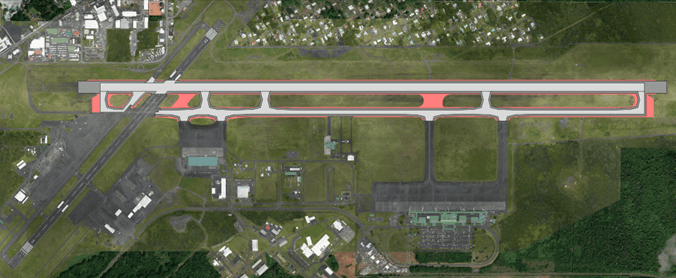
The objective of this project located at the Hilo International Airport was to repair, resurface, and replace the failed and deteriorating pavement sections on the primary runway at Hilo International Airport, the adjacent taxiways and the associated shoulders. The project will also address other areas of problematic and/or non-standard taxiway geometry, to increase safety and capacity of the airfield.
PROJECT SCOPE
The scope of this project included the following major design elements:
Reconstruct and/or rehabilitate existing asphalt runway and taxiway pavement including pavements for Runway 8-26, Taxiway A, connector Taxiways B, D, and the two Taxiway A end taxiways;
Reconstruct and/or rehabilitate all corresponding asphalt shoulder pavement;
Demolish and reconfigure asphalt connector Taxiway E to eliminate direct access from the Terminal Apron to Runway 8-26;
Reconstruct and/or rehabilitate a portion of asphalt Runway 3/21 at the intersection with Runway 8-26, depending on whether or not profile corrections are necessary.
Aeris Engineering (Aeris) provided airfield civil engineering design services specific to the construction safety and phasing plans (CSPP) including field investigations.
As the lead for the construction phasing design, Aeris was responsible for developing the Construction Safety and Phasing Plans (CSPP), including the analysis of aircraft movement simulations adjacent to work areas, aircraft parking and pushback plans, jet blast analysis, barricade placements, declared distances, open/closed or restricted runway or taxiway routes, and gate/apron restrictions. Aeris also attended and presented at key stakeholder phasing workshops and Safety Risk Assessment (SRA) meetings.
Hilo International Airport (ITO)
Runway 8-26 and Taxiway A Rehabilitation
PROJECT OBJECTIVE
The objective of this project located at the Hilo International Airport was to repair, resurface, and replace the failed and deteriorating pavement sections on the primary runway at Hilo International Airport, the adjacent taxiways and the associated shoulders. The project will also address other areas of problematic and/or non-standard taxiway geometry, to increase safety and capacity of the airfield.
PROJECT SCOPE
The scope of this project included the following major design elements:
Reconstruct and/or rehabilitate existing asphalt runway and taxiway pavement including pavements for Runway 8-26, Taxiway A, connector Taxiways B, D, and the two Taxiway A end taxiways;
Reconstruct and/or rehabilitate all corresponding asphalt shoulder pavement;
Demolish and reconfigure asphalt connector Taxiway E to eliminate direct access from the Terminal Apron to Runway 8-26;
Reconstruct and/or rehabilitate a portion of asphalt Runway 3/21 at the intersection with Runway 8-26, depending on whether or not profile corrections are necessary.
Aeris Engineering (Aeris) provided airfield civil engineering design services specific to the construction safety and phasing plans (CSPP) including field investigations.
As the lead for the construction phasing design, Aeris was responsible for developing the Construction Safety and Phasing Plans (CSPP), including the analysis of aircraft movement simulations adjacent to work areas, aircraft parking and pushback plans, jet blast analysis, barricade placements, declared distances, open/closed or restricted runway or taxiway routes, and gate/apron restrictions. Aeris also attended and presented at key stakeholder phasing workshops and Safety Risk Assessment (SRA) meetings.

Nucla Hopkins Field Airport (AIB)
Install New AWOS III-P/T
PROJECT OBJECTIVE
The objective of this project located at Nucla Hopkins Field Airport was to replace the existing Automated Weather Observing System (AWOS) with a new AWOS-IIIPT system.
PROJECT SCOPE
The scope of this project included the following major design elements:
Replacement of airport AWOS equipment
Aeris Engineering (Aeris) reviewed civil material submittals and requests for information during construction. An Aeris full time Resident Project Representative (RPR) was on-site to ensure the project is constructed in accordance with the plans and specifications.
Nucla Hopkins Field Airport (AIB)
Install New AWOS III-P/T
PROJECT OBJECTIVE
The objective of this project located at Nucla Hopkins Field Airport was to replace the existing Automated Weather Observing System (AWOS) with a new AWOS-IIIPT system.
PROJECT SCOPE
The scope of this project included the following major design elements:
Replacement of airport AWOS equipment
Aeris Engineering (Aeris) reviewed civil material submittals and requests for information during construction. An Aeris full time Resident Project Representative (RPR) was on-site to ensure the project is constructed in accordance with the plans and specifications.
Nucla Hopkins Field Airport (AIB)
Install New AWOS III-P/T
PROJECT OBJECTIVE
The objective of this project located at Nucla Hopkins Field Airport was to replace the existing Automated Weather Observing System (AWOS) with a new AWOS-IIIPT system.
PROJECT SCOPE
The scope of this project included the following major design elements:
Replacement of airport AWOS equipment
Aeris Engineering (Aeris) reviewed civil material submittals and requests for information during construction. An Aeris full time Resident Project Representative (RPR) was on-site to ensure the project is constructed in accordance with the plans and specifications.

Nucla Hopkins Field Airport (AIB)
Apron Rehabilitation and Taxiway C Reconstruction (Design)
PROJECT OBJECTIVE
The objective of this project located at Nucla Hopkins Field Airport was to rehabilitate the apron and reconstruct a portion of Taxiway C. This will consist of full depth reconstruction of existing Taxiway C pavement and an asphalt overlay rehabilitation of the existing Terminal Apron Ramp.
PROJECT SCOPE
The scope of this project included the following major design elements:
Full depth asphalt pavement reconstruction
Asphalt pavement overlay
New underdrain installation
Removal and Installation of Aircraft Tie-Downs
Pavement marking removal and installation
Seeding and mulching
Aeris Engineering (Aeris) provided airfield civil engineering design services including preparation of all civil required construction plans, contract documents and technical specifications.
Nucla Hopkins Field Airport (AIB)
Apron Rehabilitation and Taxiway C Reconstruction (Design)
PROJECT OBJECTIVE
The objective of this project located at Nucla Hopkins Field Airport was to rehabilitate the apron and reconstruct a portion of Taxiway C. This will consist of full depth reconstruction of existing Taxiway C pavement and an asphalt overlay rehabilitation of the existing Terminal Apron Ramp.
PROJECT SCOPE
The scope of this project included the following major design elements:
Full depth asphalt pavement reconstruction
Asphalt pavement overlay
New underdrain installation
Removal and Installation of Aircraft Tie-Downs
Pavement marking removal and installation
Seeding and mulching
Aeris Engineering (Aeris) provided airfield civil engineering design services including preparation of all civil required construction plans, contract documents and technical specifications.
You can trust us to land it.
You can trust us to land it.
You can trust us to land it.
You can trust us to land it.

© 2025 Aeris Engineering. All rights reserved.
© 2025 Aeris Engineering. All rights reserved.